Short answer: Apparel and supplement brands both fight crowded Meta auctions, but they win in different ways. Apparel brands win on first-order profit: raise AOV with bundles and free-shipping thresholds, cut returns with better fit content, and judge ads on MER net of returns. Supplement brands win on lifetime value: keep every claim compliant, lead with subscriptions and starter offers instead of big promises, and judge acquisition on how fast repeat orders pay back CAC. Both need a steady creative testing cadence and a blended MER target, not platform ROAS alone.
On the surface the two categories look alike. Both are huge, both have low barriers to entry, both are full of white-label products and both rely heavily on Meta and TikTok for new customers. That's why CPMs are high and why "just run more ads" rarely works in either one.
Underneath, the economics are close to opposite. An apparel order is often a one-time purchase until the next season or drop, and a meaningful share of orders come back as returns or exchanges. A supplement order is designed to repeat every 30 days, rarely comes back, but lives under strict advertising rules about what you can say. Apparel has to make money now. Supplements can afford to lose a little now if the customer stays.
That difference changes how you set targets, what offers you run, what creative you test and which numbers you trust. The sections below are written so each one stands on its own. Read the one for your brand, then the shared section.
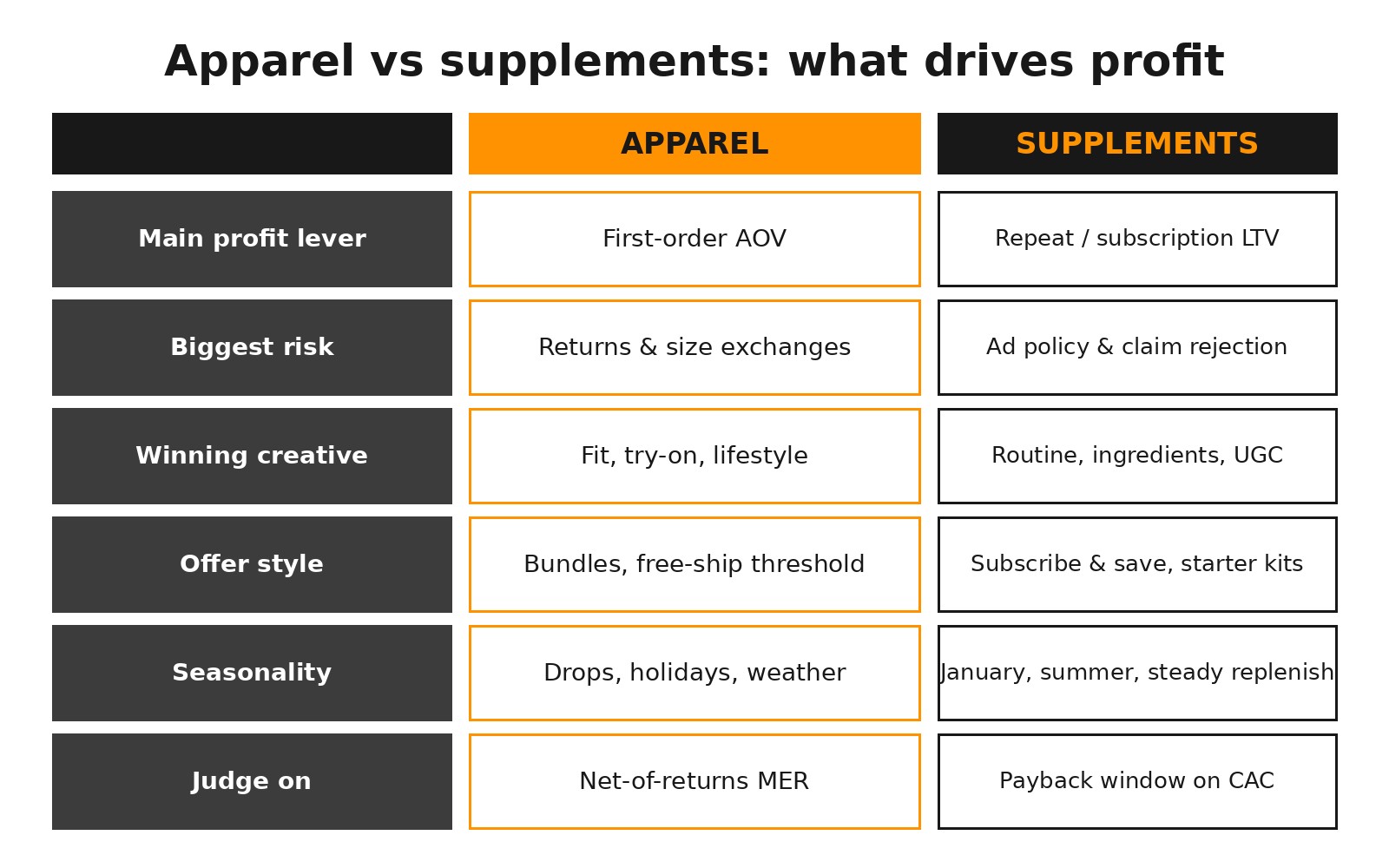
For most apparel brands, first-order AOV decides whether paid social works at all. If your CPA is $45 and your average order is $55 with a 60% gross margin, you lose money on every new customer before returns. Push AOV to $85 and the same CPA becomes profitable.
The levers that move apparel AOV without discounting the brand into the ground:
Returns are the hidden tax on apparel ads. A campaign that shows a 3x ROAS in Ads Manager might be closer to 2.2x after a 25% return rate is netted out. That's why apparel brands should always measure MER on net revenue.
The most effective return fixes are also conversion fixes:
Track return rate by ad and by product. If one creative drives a much higher return rate, it is probably setting the wrong expectation about fit, color or fabric, and it should be cut even if its front-end ROAS looks good.
Apparel is bought with the eyes, then confirmed with the fit. The creative mix that consistently works:
Apparel demand swings with weather, holidays and drops. Plan creative and inventory together: build seasonal creative four to six weeks ahead, raise budgets as the season starts rather than at its peak, and pull spend back from products that are about to sell out. Product launches and limited drops work best with a warm-up period of teaser content and email/SMS sign-ups before paid spend scales. For BFCM, set a separate MER target for the promo window.
Large catalogs with many sizes and colors create two ad problems: spend spreads across too many products, and ads drive traffic to items with broken size runs. Keep your product feed clean, exclude low-stock or out-of-size variants from catalog ads, and concentrate prospecting creative on your top 10–20% of products by margin and stock depth. Tie ad plans to inventory planning so a winning ad never runs into a stockout.
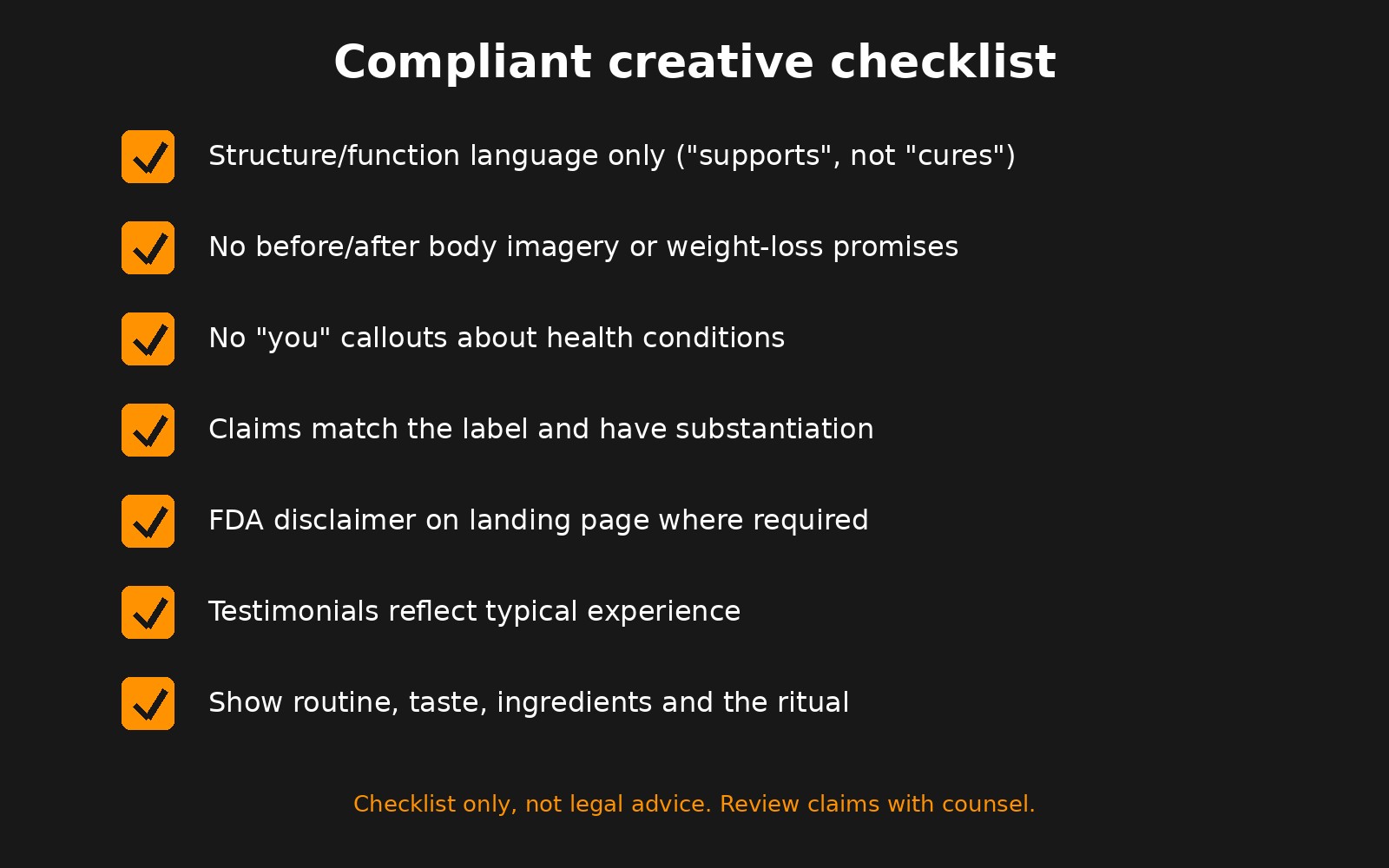
Supplement ads live under two sets of rules: the law (in the US, FTC truth-in-advertising rules and FDA rules on structure/function claims) and the ad platform's own policies. Breaking either can mean rejected ads, a restricted ad account or legal risk. This is not legal advice, so have claims reviewed by counsel, but the practical guardrails are consistent:
When you can't make big promises, the offer has to do more of the selling. Strong supplement offers reduce risk and reward commitment:
Because supplement customers can repeat every month, you can often afford a first-order CPA above first-order profit, as long as you know your payback window. Calculate contribution margin per order, multiply by expected orders in 90 or 180 days, and set your maximum CPA from that number, not from the first order alone. Track cohort retention monthly. If month-two retention drops, your acquisition targets have to tighten right away. Learn more about customer acquisition cost.
Compliant supplement creative sells the experience, the ingredients and the routine instead of the outcome:
Start from contribution margin. Apparel brands should set a blended MER on net revenue after returns; a brand with 60% gross margin and 25% returns typically needs a higher MER than its ROAS suggests. Supplement brands can set a first-order MER below break-even if 90-day repeat revenue closes the gap. See our full guide to MER vs ROAS for the math.
In crowded categories, creative is the main targeting lever. Most brands spending $30k–$150k a month on Meta need 4–10+ new concepts a week, with clear kill and scale rules. Our creative testing cadence guide covers volume tiers and budgets, and why Meta ads stop scaling explains what to do when spend stalls.
Use a pre-sell page when the product needs explaining before the buy: a new supplement format, an ingredient story, or a premium apparel fabric that needs to justify its price. Send familiar, impulse-friendly products straight to the product page. Read how pre-sell pages turn cold clicks into buyers.
Illustrative apparel example. A brand spends $40,000 a month on Meta with a $60 AOV, 60% gross margin and a 25% return rate. Moving to a "3 for $99" bundle and a $90 free-shipping threshold raises AOV to $82. Adding try-on video and fit notes lowers returns to 18%. At the same spend and order count, net revenue rises by roughly 50%, and MER on net revenue moves from about 2.0 to about 3.0.
Illustrative supplement example. A brand pays a $50 CPA on a $45 first order with $30 contribution margin, so it loses $20 per new customer on day one. With a subscribe-and-save offer, 55% of customers subscribe and the average customer places 3.2 orders in 180 days, worth about $96 in contribution. The real payback happens on order two, and the brand can safely bid up to around $60–$70 CPA to grow faster.
These figures are examples to show the math, not client results.
Lion Media has managed $50M+ in ad spend at a 4.9x average ROAS, with a 5.0★ client rating. We've worked with DTC brands including Cion, PIPWellness, Honey Drop and Slouper, applying the same approach: set the right MER target for the category, build compliant, testable creative and fix the offer before scaling spend. See how we run accounts as a Meta ads agency for DTC and a full-funnel performance marketing agency.
We'll review your offers, creative, returns or retention and MER targets and show where your account is leaking profit. Book a free growth audit with Lion Media.
Yes. Supplement ads are allowed if they avoid disease claims, before/after imagery and personal health callouts, and only make claims supported by the label and evidence.
It depends on margin and returns. Many apparel brands need a 2.5–4x platform ROAS, but the better test is blended MER on net revenue after returns meets your contribution target.
Show fit honestly: try-on video, model sizes, fit notes from reviews and clear size charts. Cut ads that drive above-average return rates even if their ROAS looks strong.
Usually yes. Subscribe-and-save offers with easy skip and cancel raise LTV and let you afford a higher CPA, as long as you track cohort retention and payback.
At $30k–$150k a month on Meta, plan for 4–10+ new concepts a week. Apparel leans on fit and lifestyle; supplements lean on routine, ingredients and UGC about the experience.
Often. A pre-sell page lets you explain ingredients, format and routine in compliant language before the offer, which tends to help new or unfamiliar products convert.
Book a free 30-minute growth audit. We'll review your ads, tracking and site, and show you where the profit is leaking.
No commitment. No pitch deck. A real conversation about your growth architecture.