
Short answer: In the Advantage+ era, creative is your targeting. Most DTC brands should launch a set number of new, clearly different ad concepts every week, scaled to spend (about 2–3 per week under $10k/month, 5–8 at $30k–$100k, 15+ above $300k). Put roughly 10–30% of budget into testing, judge each concept against fixed spend, CTR and CPA/MER gates, and move winners into scaling campaigns. Volume of distinct ideas beats endless audience tweaks.
A few years ago, a media buyer's edge came from audiences: stacking interests, slicing lookalikes, and excluding the right segments. That edge is mostly gone. Advantage+ Shopping campaigns, broad targeting and Meta's AI ranking models now decide who sees your ads, and they are better at it than manual targeting for most DTC brands.
What the system cannot do is invent reasons for people to buy. It can only work with the ads you give it. Each creative acts like a signal: a problem-focused UGC video will find one kind of buyer, a clean before/after static will find another, and a price-value carousel will find a third. When you feed the system more distinct creative, you are effectively giving it more audiences to find.
That is why brands that spend hours adjusting audiences and bid settings often stall, while brands that ship new concepts every week keep growing. Three things happen when creative volume drops:
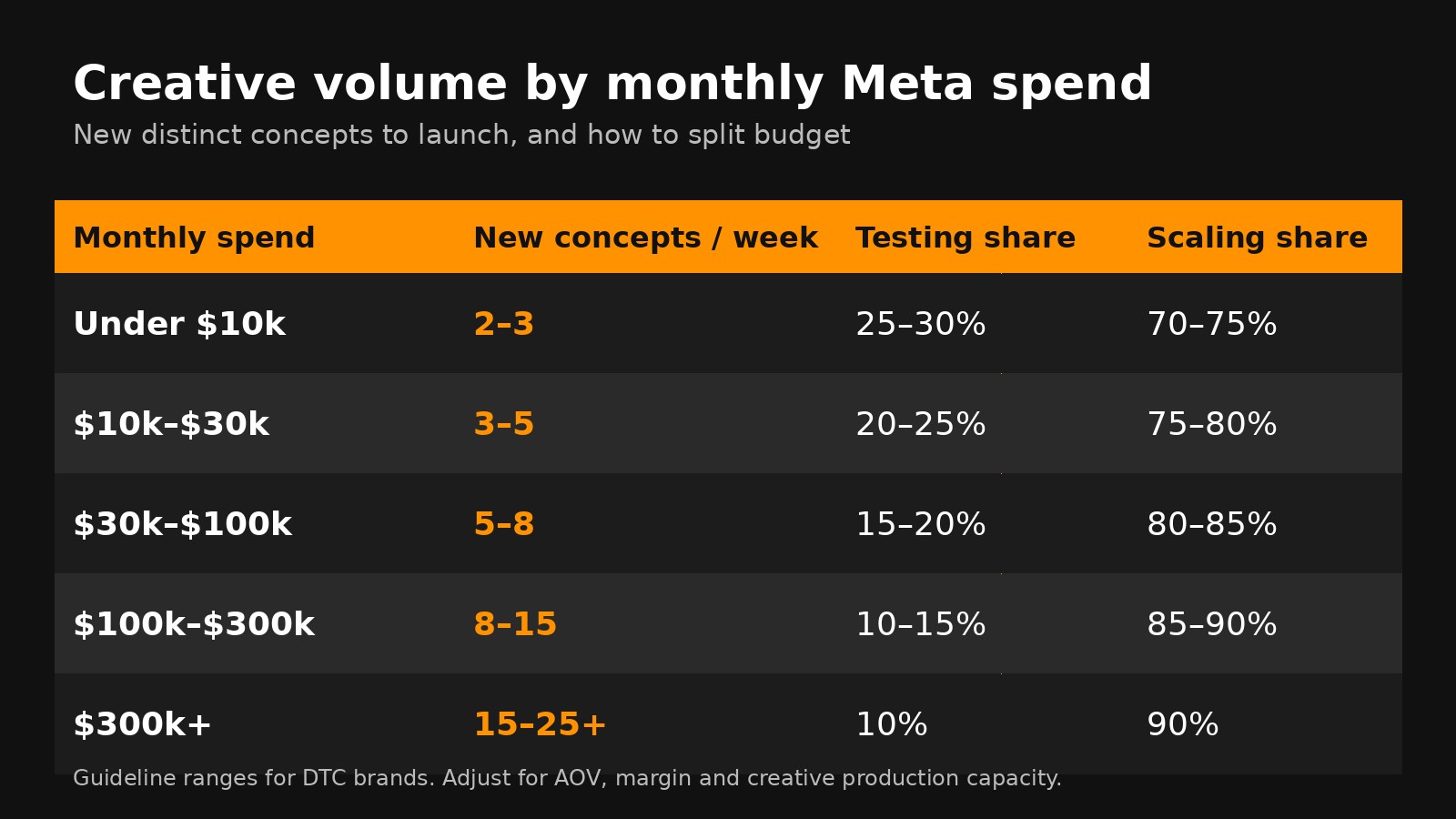
The right number depends on how much you spend. More spend means more impressions, which means creative wears out faster and the system needs more options. Use these ranges as a starting point:
| Monthly Meta spend | New concepts per week | Variations per winner | Typical refresh need |
|---|---|---|---|
| Under $10k | 2–3 | 2–3 | Winners can run 6–10 weeks |
| $10k–$30k | 3–5 | 3–4 | Refresh top ads every 4–6 weeks |
| $30k–$100k | 5–8 | 3–5 | Refresh every 3–4 weeks |
| $100k–$300k | 8–15 | 4–6 | Refresh every 2–3 weeks |
| $300k+ | 15–25+ | 5+ | Continuous pipeline |
A "concept" here means a new idea: a different angle or a different core message, not a new color or a new caption. Variations (new hooks, lengths, aspect ratios) sit on top of that count.
If you can't hit the number, launch fewer but keep the rhythm. A steady two concepts every week beats ten in one week and nothing for a month, because the system and your team both learn from a consistent cadence.
Testing is how you find the next winner; scaling is how you make money from the ones you have. You need both. A simple rule:
Make sure each new concept can get enough spend to be judged. A good working minimum is 1–2× your target CPA per concept before you make any call. If your test budget can't cover that for your weekly concept count, either raise the test budget or launch fewer concepts. Spreading too little money over too many ads gives you noise, not answers.
Judge the testing budget against blended results, not just in-platform ROAS. If your overall MER holds while you test, the program is paying for itself.
Write your rules down before you launch. It stops emotional decisions and keeps the whole team consistent. Here is a starting framework you can adjust to your margins:
| Gate | Check | Action |
|---|---|---|
| 1. Early signal | After ~0.5× target CPA in spend: thumb-stop rate (3-second views ÷ impressions) under ~20% for video, or CTR (link) well below your account average | Kill or rework the hook |
| 2. Click quality | After 1× target CPA: CTR at or above account average but no add-to-carts | Check the landing page and offer match before killing |
| 3. Cost gate | After 2× target CPA: CPA more than ~30% above target | Kill |
| 4. Winner | CPA at or below target over 3+ purchases, and stable for 3–5 days | Move to scaling campaign; brief 3–5 new hooks |
| 5. Scale check | After scaling: blended MER holds at your floor as spend rises | Keep scaling in 20–30% steps |
Two notes. First, don't kill a concept on a single bad day; look at a few days of data. Second, a winner in testing is a hypothesis, not a promise. Confirm it by watching MER at the account level when you move it into scaling, which is the same logic we use in our Advantage+ guide for MER-focused brands.
The fastest way to keep a pipeline full is to stop starting from a blank page. Break every ad into three parts:
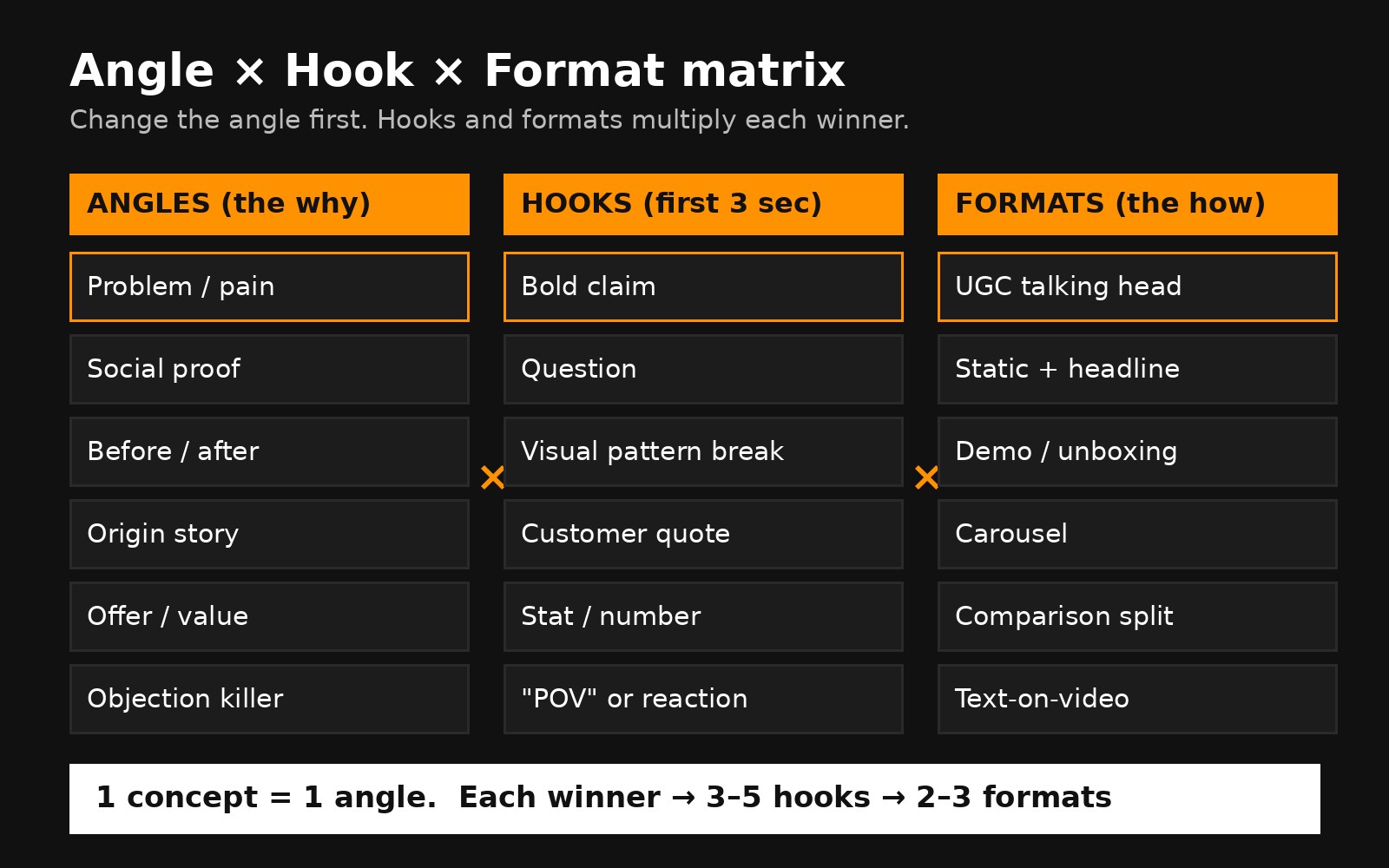
Use the matrix in this order. New concepts come from new angles, because the angle decides who the ad speaks to. Once an angle wins, multiply it with new hooks to fight fatigue, then new formats to reach people who respond to different styles. For a full process to generate ideas for each column, see the ad idea engine.
Good sources for angles: customer reviews (both 5-star and 3-star), support tickets, post-purchase surveys, competitor comments, and the questions your sales or support team hears every week.
Meta's AI ranking changes made this clearer than ever. The system now looks at what an ad actually is (the visuals, the message, the people in it) and groups ads that look and say the same thing. If you upload ten versions of one ad with a different background color, it treats them as roughly the same ad. They compete for the same people and the same impressions.
A truly different concept, on the other hand, earns its own chance to find a new pocket of buyers. In practice:
Brands that switch from "many variations" to "fewer, more distinct concepts" often see lower CPMs and more stable scaling, because fatigue spreads across more unique ideas.
Keep it simple. Most DTC accounts do well with:
When you move a winner, duplicate it using the same post ID so it keeps its social proof (likes and comments). Leave the original running in testing for a few days so you don't lose the signal while the scaling version ramps up.
Cadence breaks when production depends on one person or one big shoot. A few habits help:
This is where a dedicated creative team pays off: not as a "secret weapon," but as a system that ships the right number of distinct concepts every week and feeds results back into the next brief.
For Cion, a full-funnel Meta rebuild with structured creative testing and server-side tracking helped deliver 90% revenue growth, a 4.9x Meta ROAS and a 67% conversion-rate improvement. For Honey Drop, a TikTok-first strategy built on native video creative drove the brand's highest single-month revenue in its history, with a 59% CVR improvement and 4.4x TikTok ROAS.
Across clients including Cion, PIPWellness, Honey Drop and Slouper, Lion Media has managed $50M+ in ad spend at a 4.9x average ROAS, with a 5.0★ client rating. See how we run creative testing for paid social on our Meta ads agency for DTC brands page, or browse our service hubs and client work.
We'll review your account, your current creative mix and your MER floor, and show you how many concepts to launch and how to split budget. Book a free ad account audit with Lion Media.
It depends on spend. As a guide: 2–3 new concepts per week under $10k/month, 3–5 at $10k–$30k, 5–8 at $30k–$100k, 8–15 at $100k–$300k, and 15 or more above $300k. Count distinct concepts, not small variations.
Usually 10–30%. Smaller accounts should test more (20–30%) because they have fewer proven winners; larger accounts can test 10–15% because that is already a large absolute budget.
Give each concept at least 1–2× your target CPA in spend before deciding. You can kill earlier if the hook clearly fails, for example a very low thumb-stop rate or CTR after about half your target CPA.
A concept is a new idea, usually a new angle or message. A variation changes a smaller part of a proven concept, such as the hook, length, caption or aspect ratio. New concepts find new buyers; variations extend the life of winners.
Less than before. With Advantage+ and broad targeting, Meta's AI decides who sees your ads. Your creative now does most of the targeting work, so time spent on new concepts usually pays back more than time spent on audience tweaks.
Watch for rising frequency, falling CTR and rising CPA over a week or more on the same ad. When those move together, add new hooks or formats for that angle and keep new concepts coming into testing.
Book a free 30-minute growth audit. We'll review your ads, tracking and site, and show you where the profit is leaking.
No commitment. No pitch deck. A real conversation about your growth architecture.