Short answer: Customer acquisition cost (CAC) is the total cost to win one new customer: acquisition spend for a period divided by the new customers acquired in that period. For a DTC brand in 2026, the useful version is new-customer CAC calculated from store data, not the CPA an ad platform reports. Then compare it with what a customer is worth: first-order contribution margin and how many months it takes repeat purchases to pay CAC back.
CAC is what it costs your business to gain one new paying customer. It sounds simple, but most confusion comes from two choices: which costs go on top, and which customers go on the bottom.
Costs to include. At minimum, include paid media spend. For a fully loaded CAC, add agency or freelancer fees, creative production (UGC, shoots, editing), affiliate and influencer payments, and tools used mainly for acquisition. Leave out costs that serve existing customers, such as retention email software, unless you are deliberately calculating a blended number.
Customers to count. Count first-time buyers only. Repeat orders are not acquisitions. If your store reports mix new and returning orders, fix that first, because dividing spend by all orders makes CAC look far better than it is.
CAC = acquisition spend ÷ new customers acquired (same period, usually a month).
| Month | Acquisition spend | New customers | CAC |
|---|---|---|---|
| A | $30,000 | 600 | $50 |
| B | $45,000 | 750 | $60 |
Illustrative figures, not client results. Spend rose 50 percent but new customers rose 25 percent, so CAC climbed from $50 to $60. That is a normal sign of scaling into broader, less ready-to-buy audiences. Whether it is a problem depends on payback, covered below.
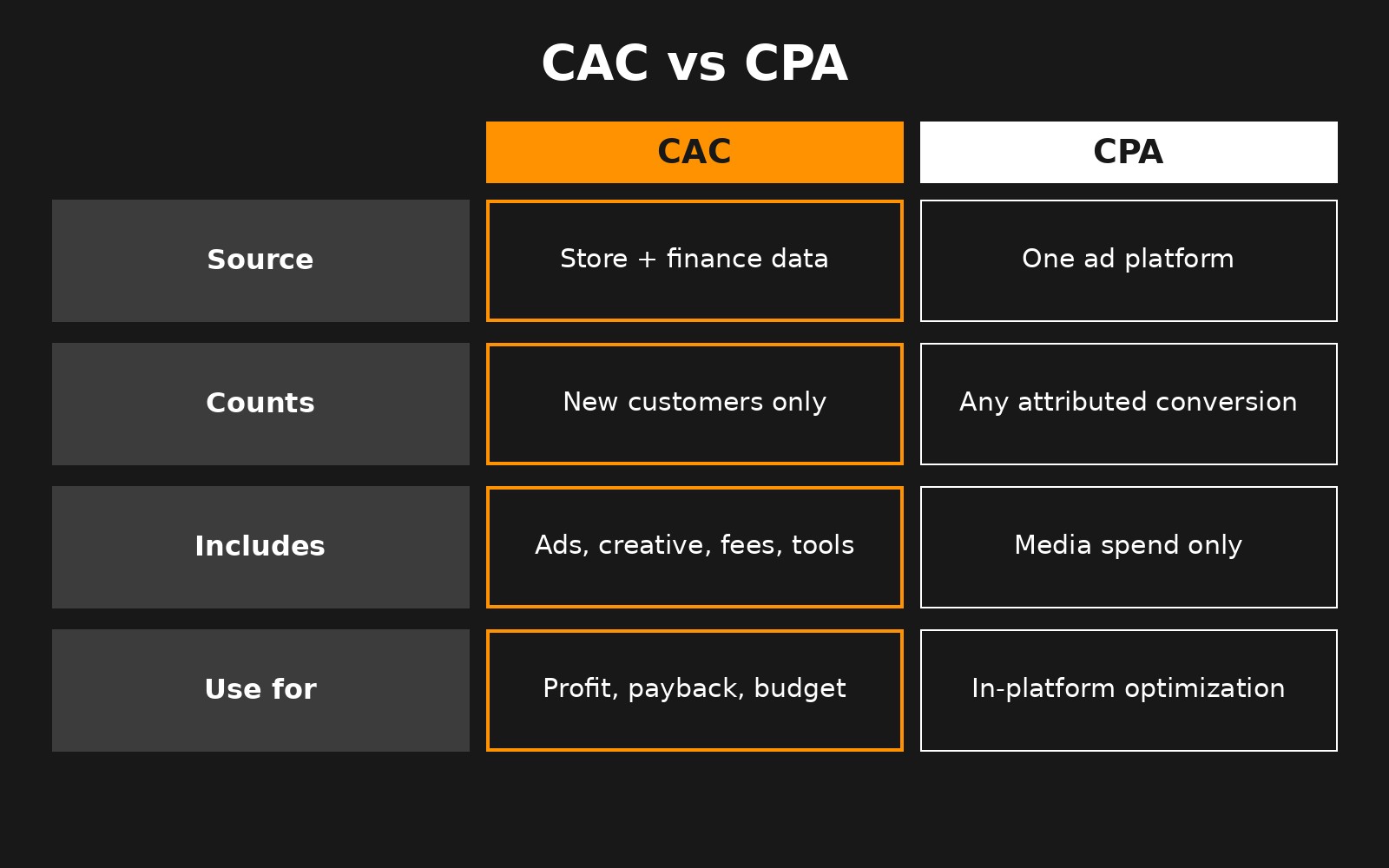
CPA (cost per acquisition) is the cost per conversion that one ad platform attributes to itself. It counts any purchase it can claim, including returning customers and people who would have bought anyway, and it ignores costs outside that platform. CPA is a good signal for choosing which ads and audiences to scale inside the platform. CAC is what you use for profit, payback and budget decisions.
CAC payback period is how long it takes a new customer's contribution margin to cover the cost of acquiring them. Contribution margin here means revenue minus product cost, shipping, payment fees and discounts, before marketing.
CAC payback (months) = CAC ÷ monthly contribution margin per customer, after subtracting what the first order already earned.
The numbers below are an illustrative example for a replenishable DTC product, not client results.
| Input | Value |
|---|---|
| New-customer CAC | $60 |
| First-order AOV | $60 |
| First-order contribution margin (40%) | $24 |
| Average repeat contribution margin per customer per month | $8 |
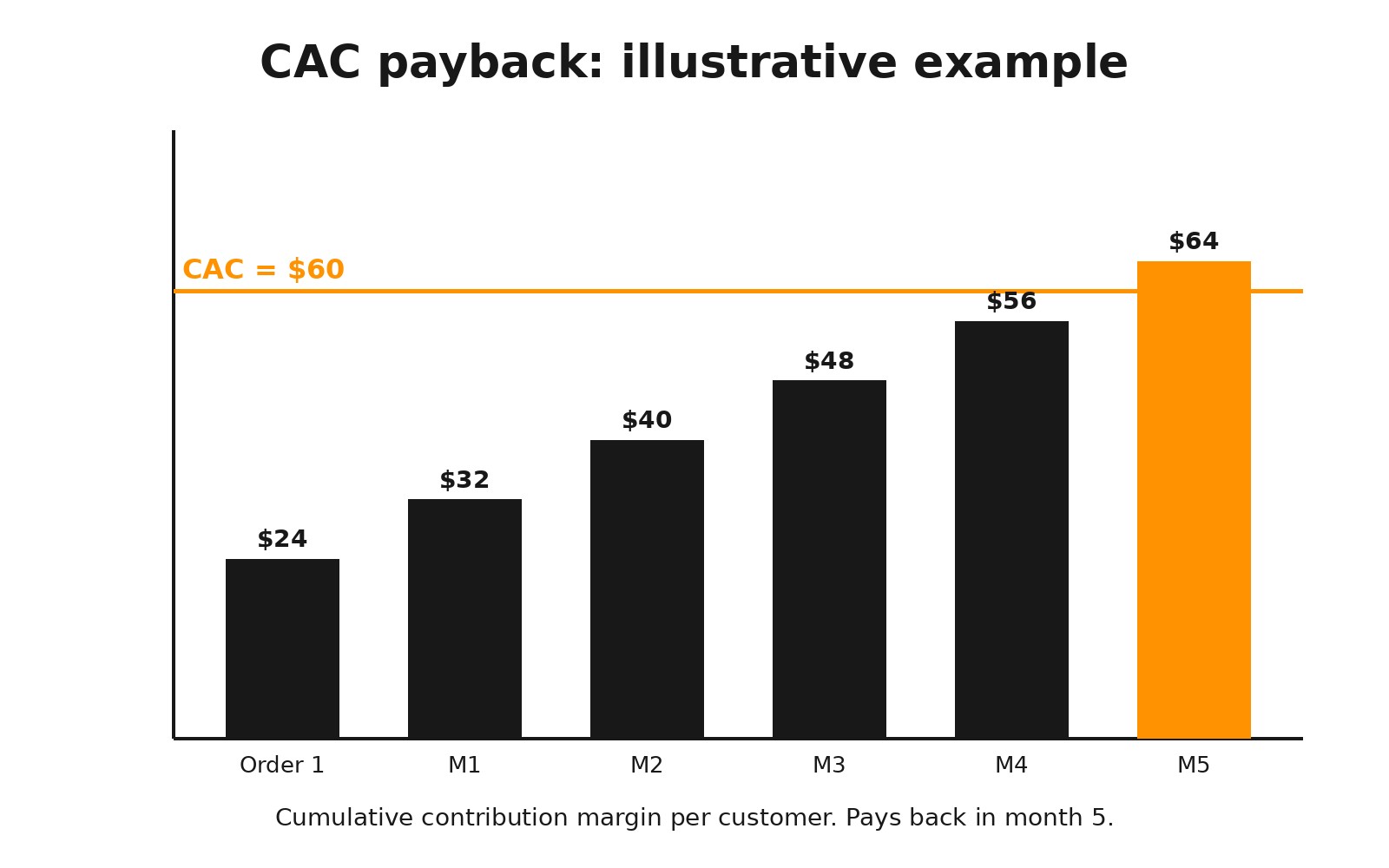
What this tells you: every new customer ties up cash for about five months. If your cash position or financing can carry that, you can keep scaling at $60 CAC. If CAC rises to $80, payback stretches to about 7 months ($56 ÷ $8), and you need either more cash, a higher AOV, better repeat rate or a cap on spend.
There is no universal good CAC number. A $90 CAC can be excellent for a brand with $70 first-order margin and strong repeat, and a $25 CAC can lose money on a $30 one-time product. Judge CAC against three things:
MER (marketing efficiency ratio) is total revenue ÷ total marketing spend. It tells you whether the business as a whole is efficient. New-customer CAC tells you whether that efficiency is coming from buying new customers or just from returning buyers. Watch them together:
Our MER vs ROAS guide shows how to set break-even and target MER. To tie CAC, MER and budget together on one page, use the one-page DTC growth plan.
For a fully loaded CAC, yes. Track media-only CAC for channel decisions and fully loaded CAC for profitability, and label each clearly.
CAC is acquisition spend divided by new customers, from your store data. CPA is the cost per conversion a single ad platform attributes to itself, which can include returning customers and double-counted sales.
Subtract first-order contribution margin from CAC, then divide what remains by the average monthly contribution margin per customer from repeat purchases. The result is the number of months to pay back.
It depends on cash flow and category. Many replenishable DTC brands aim for roughly 3 to 6 months, while low-repeat categories often need CAC covered by the first order.
As spend grows, platforms reach broader audiences who are less ready to buy, so each new customer costs more. Rising CAC is acceptable as long as payback and MER stay within target.
Use blended CAC for the overall health of the business and paid CAC for channel planning. Blended CAC is less affected by broken attribution.
Want help setting CAC and payback targets for your brand? Talk to Lion Media.
Book a free 30-minute growth audit. We'll review your ads, tracking and site, and show you where the profit is leaking.
No commitment. No pitch deck. A real conversation about your growth architecture.