You stop running out of ad ideas by turning ideation into a system. Collect customer language from reviews, comments and support tickets, keep running lists of angles, personas, hooks and formats, then combine them into distinct concepts. Every test result feeds back into those lists, so each round of ads starts from proven insight instead of a blank page.
The best ad ideas are already written by your customers. Your job is to collect them. Good sources, in rough order of value:
Keep a shared "voice of customer" doc. Paste exact phrases, not summaries. "I finally stopped waking up sweaty" is a hook; "customers like the cooling feature" is not.
Make four lists, then combine them:
| Angles | Personas | Hooks | Formats |
|---|---|---|---|
| Problem/solution | First-time buyer | Question | UGC video |
| Social proof | Gift buyer | Bold claim you can prove | Static comparison |
| Us vs them | Repeat customer | Demo in first seconds | Carousel |
| Objection handling | Skeptical researcher | Customer quote | Talking-head explainer |
Four angles, four personas, four hooks and four formats give 256 combinations. You will never test them all, and you should not. The point is that you never face a blank page: pick the combinations that match your current objections and offers, and you have a week of concepts in minutes.
Definitions that keep the team aligned:
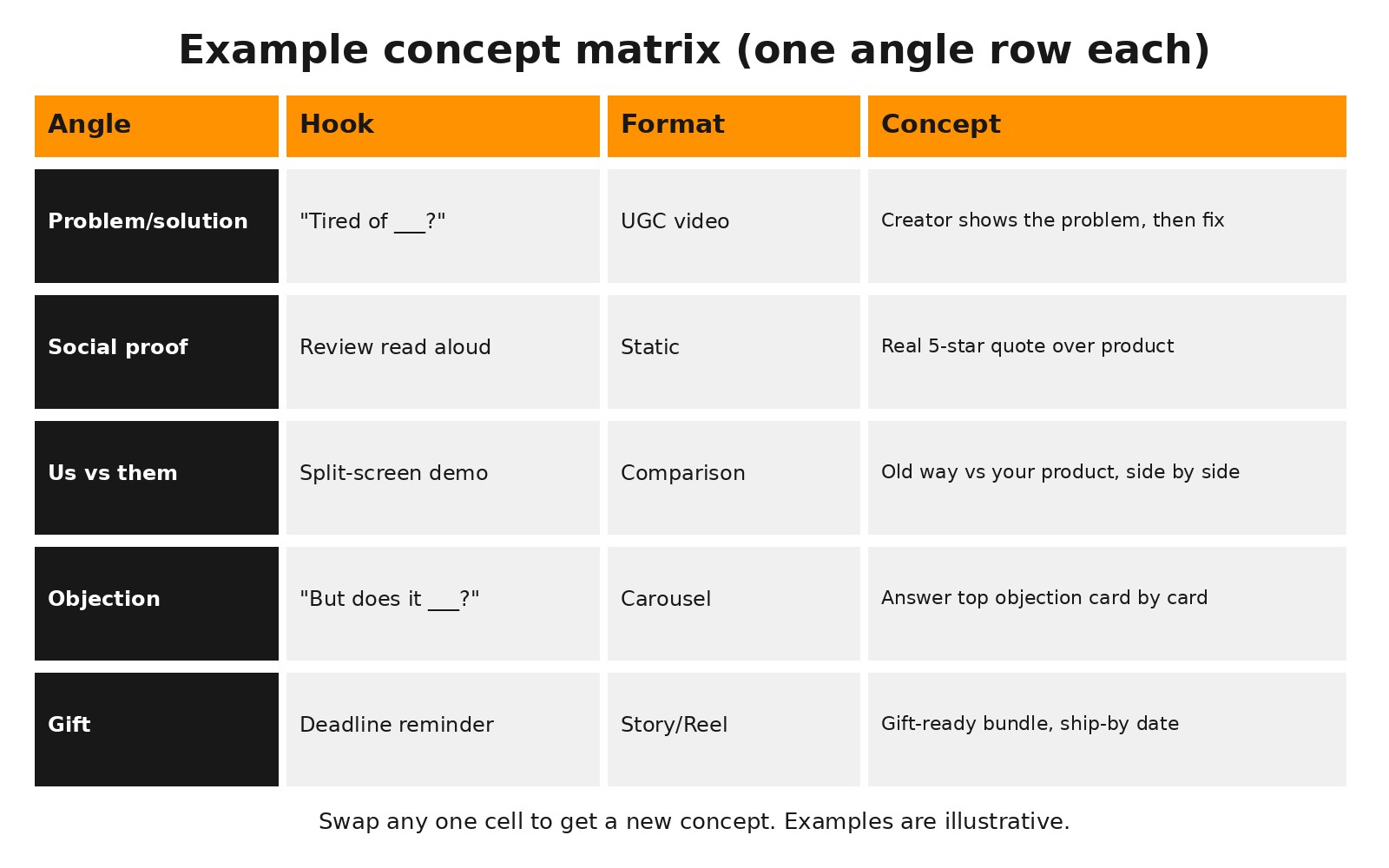
Here is the same idea as a working table for a hypothetical home goods brand. These are illustrative concepts, not client ads.
| Angle | Persona | Hook | Format | Concept |
|---|---|---|---|---|
| Problem/solution | First-time buyer | "Tired of ___?" | UGC video | Creator shows the daily frustration, then the product fixing it |
| Social proof | Skeptical researcher | Review read aloud | Static | A real five-star review quote over a clean product shot |
| Us vs them | Repeat category buyer | Split-screen demo | Comparison | Old way vs your product side by side, same task |
| Objection handling | Skeptical researcher | "But does it ___?" | Carousel | One card per top objection, answered with proof |
| Gift | Gift buyer | Deadline reminder | Story/Reel | Gift-ready bundle with a real ship-by date |
Notice each row changes the angle, not just the color or the headline. That is what makes it a concept rather than a variation, and it is why Meta can find different pockets of buyers for each one.
Most ads lose people in the first two seconds. Strong hooks share a few traits:
Write five hooks for every winning body. The hook is the cheapest part of an ad to change and often the biggest lever on hook rate and cost per purchase.
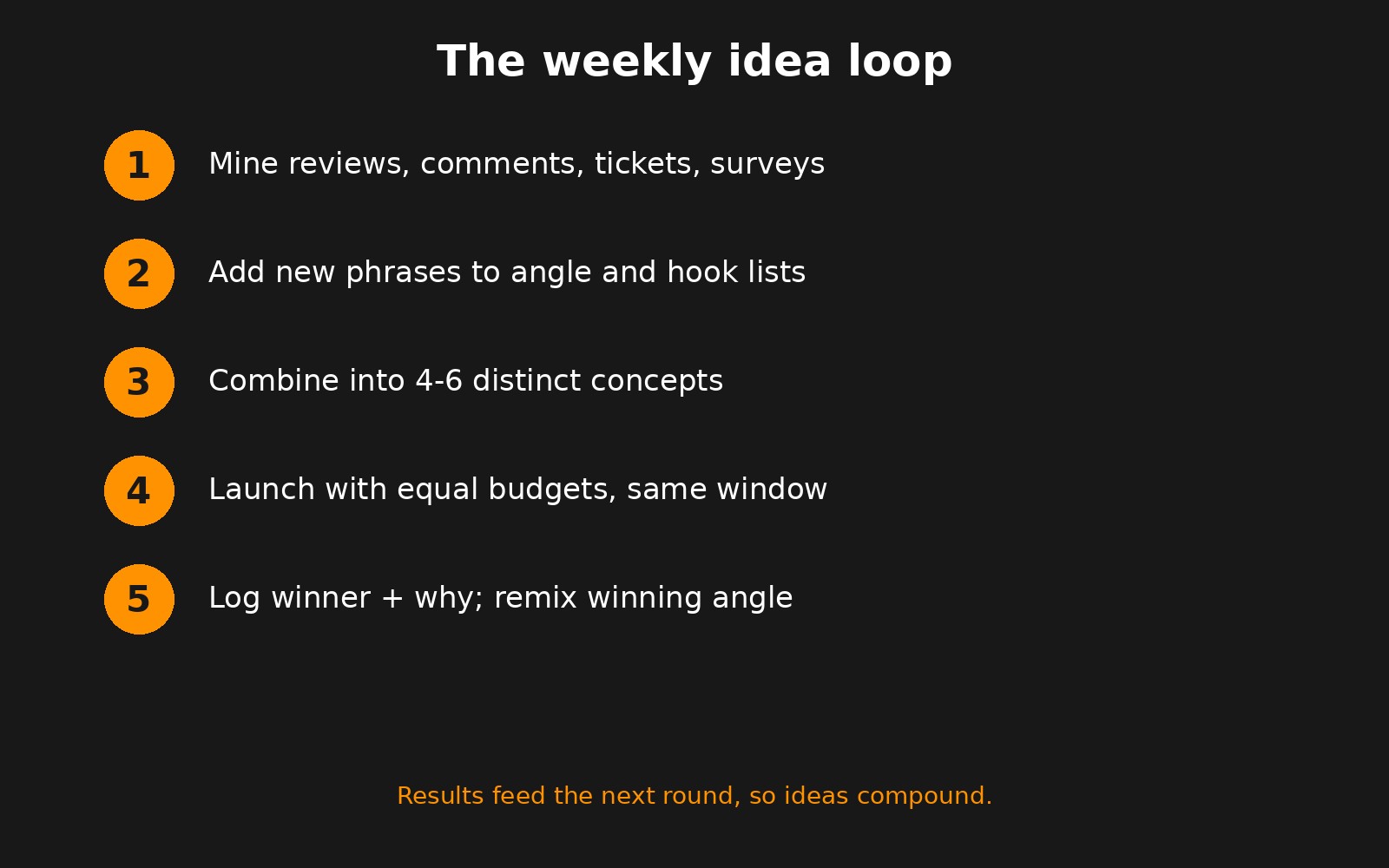
Launch several concepts at once with similar budgets, judge them on cost per purchase and hook rate, and keep the test window consistent. Broad targeting lets the creative find its audience (why your Meta ads aren't scaling even with a solid ROAS).
How many concepts and how much budget depends on your spend. Our creative testing cadence and budget guide lays out volume by spend tier and simple kill/scale rules. A practical starting rule: give each concept enough spend to reach a meaningful number of purchases before you judge it, and judge early signals (hook rate, click-through rate) only as tie-breakers.
When a concept wins, keep the angle and change the hook, persona or format. Record why it worked in one sentence. A winning problem/solution UGC ad might become:
Losers matter too. Write down why you think they lost so you do not repeat the same mistake. Over a few months this test log becomes your most valuable creative asset. This loop is what a dedicated creative studio runs for clients, and what our Meta ads agency team builds into weekly sprints.
An idea engine only works if ideas are easy to find and easy to brief. Keep one shared sheet or board with a row per concept and these columns:
| Column | What goes in it |
|---|---|
| Concept name | Short label, such as "Objection: does it fit small spaces" |
| Angle / persona / hook / format | The four matrix cells, so you can filter by any of them |
| Source | The review, comment or ticket the idea came from |
| Status | Idea, briefed, in production, live, judged |
| Result | Win, loss or inconclusive, with cost per purchase and hook rate |
| Why | One sentence on why you think it won or lost |
Score new ideas quickly before you brief them: how strongly the customer evidence supports it, how different it is from what is already live and how cheap it is to produce. Brief the top few each week and park the rest. A backlog of scored ideas means a creator or designer can start the moment a slot opens, instead of waiting on a brainstorm.
Cold audiences usually respond to problem/solution and us-vs-them angles, because they do not know you yet. People who have visited the site respond better to proof and objection handling. Past buyers respond to new products, bundles and gift angles. Tag each concept with the stage it is meant for so your mix covers the whole funnel, and so retargeting does not show the same intro ad a buyer saw a month ago (see retargeting and catalog ads in the Advantage+ era).
Pair new concepts with a strong offer (how to craft a killer offer without discounting) and a page that matches the ad (the product page playbook).
We'll review your setup and show you the highest-leverage fixes. Book a free growth audit with Lion Media.
A handful of distinct concepts per round is a practical start for most budgets. Scale the number with spend so each concept still gets enough purchases to judge.
A concept changes the angle or message. A variation changes small details like color or headline. Concepts drive bigger learning.
Rising frequency, falling CTR and rising cost per purchase over a sustained period.
Yes, for drafting hooks and scripts, but ground them in real customer language and test results.
Book a free 30-minute growth audit. We'll review your ads, tracking and site, and show you where the profit is leaking.
No commitment. No pitch deck. A real conversation about your growth architecture.