Short answer: In the Advantage+ era, retargeting and catalog ads still earn a place in a DTC Meta account, but a smaller and more disciplined one. Let Advantage+ Shopping (ASC) or broad prospecting carry 75–85% of spend, cap warm retargeting and dynamic catalog ads at roughly 15–25% combined, exclude recent purchasers everywhere, and prove the value of every retargeting dollar with a holdout test. Retargeting that can't show incremental lift over a no-ads control group is usually buying sales you would have gotten anyway.
A few years ago, a typical DTC Meta account was built in layers: cold interest audiences at the top, website and engagement custom audiences in the middle, and dynamic product ads (DPA) chasing cart abandoners at the bottom. Each layer had its own campaign, budget and audience. Retargeting often reported the best ROAS in the account, so it got protected and fed.
Three things changed that playbook. First, signal loss from iOS privacy changes and shorter attribution windows made custom audiences smaller and less complete. Second, Meta moved to automated campaign types, Advantage+ Shopping Campaigns and Advantage+ audience, that decide for themselves who sees an ad, including past visitors and customers. Third, DPA was folded into "Advantage+ catalog ads," which can serve products to both new and returning people instead of only retargeting.
The result: the walls between prospecting and retargeting are mostly gone. The algorithm will find warm people with or without a separate retargeting campaign. The real questions now are how much you let it spend on people who already know you, and whether that spend causes sales or just takes credit for them. If you're new to the automated side, start with our guide to Advantage+ for MER-focused DTC brands.
ASC treats your entire audience, including site visitors, engagers and existing customers, as fair game. Meta lets you define "existing customers" (from a customer list, pixel purchasers or Shopify data) and set a cap on how much of the ASC budget can be spent reaching them. Many accounts never set this, so ASC drifts toward the cheapest conversions: people who were going to buy anyway.
When you then run a separate retargeting campaign on the same people, you get overlap. Two campaigns bid on the same users, platform attribution counts the same purchase in both, and reported ROAS looks great while new-customer revenue stays flat. Common signs of overlap:
The fix isn't to kill retargeting. It's to give each campaign a clear job: ASC and broad prospecting find new customers (with an existing-customer cap of around 10–25%), and a small retargeting layer handles specific warm moments ASC handles poorly, such as cart recovery, high-consideration products and replenishment.
For most DTC brands spending $20k–$500k a month on Meta, a good starting point is:
Total retargeting should rarely exceed 25% of Meta spend. Warm audiences are finite. Once you've reached most of them a few times, extra budget just raises frequency and cost per result. Smaller brands with little traffic often need less than 15%, because their warm pools are tiny. Brands with heavy organic, email and influencer traffic can justify the upper end.
Treat these as caps, not targets. If a holdout test (below) shows retargeting adds little, move the money to prospecting and new creative. Retargeting audiences only grow when prospecting fills them, so starving the top of the funnel to feed the bottom shrinks both over time.
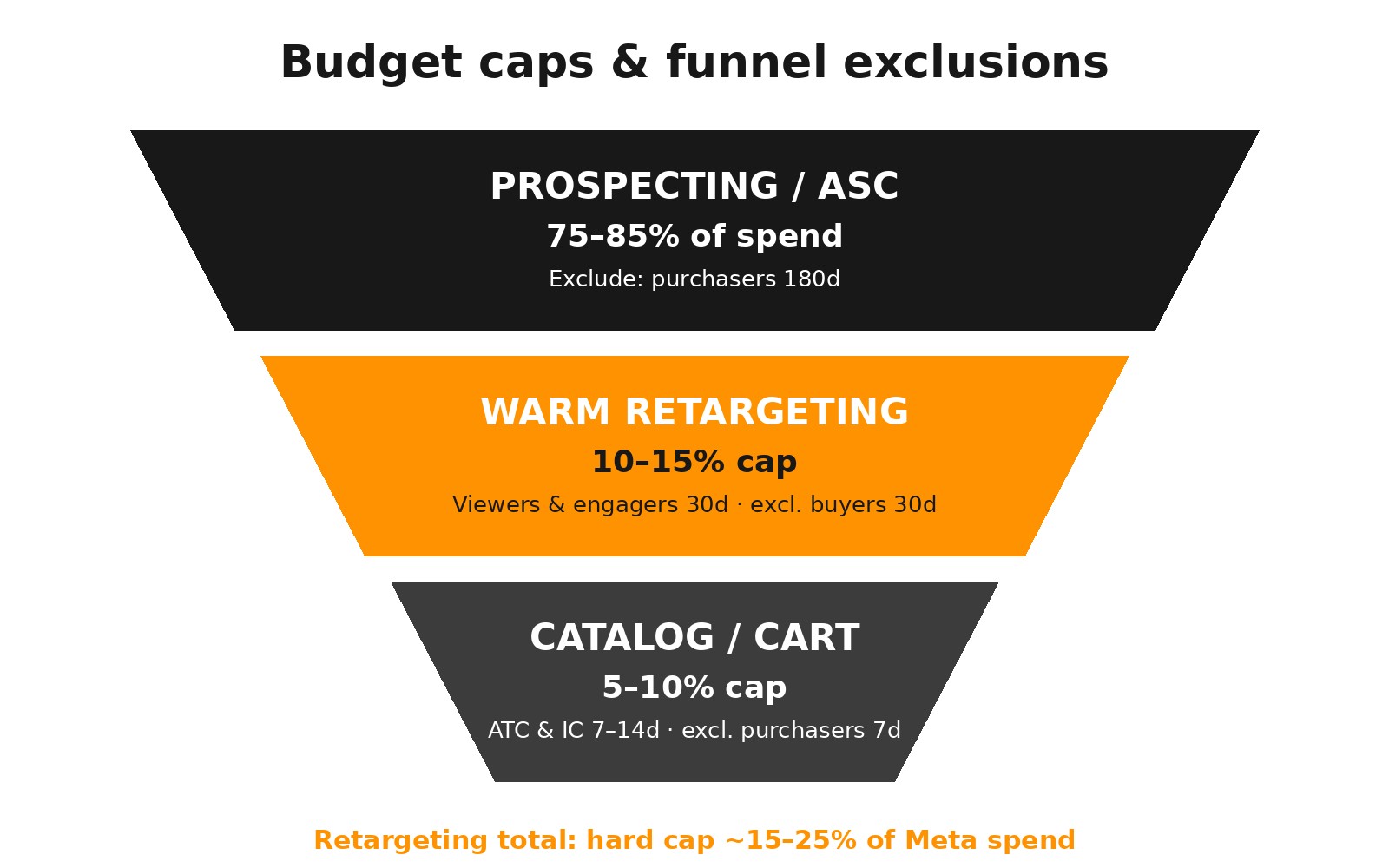
Exclusions are the cheapest performance gain in most accounts we audit. They stop you paying to reach people who just bought and keep campaigns from competing for the same user. A baseline set:
Two practical notes. Exclusion audiences need clean purchase data, so check your pixel and Conversions API setup before relying on them; our tracking services cover this. And refresh customer lists at least monthly, or connect Shopify so they sync automatically.
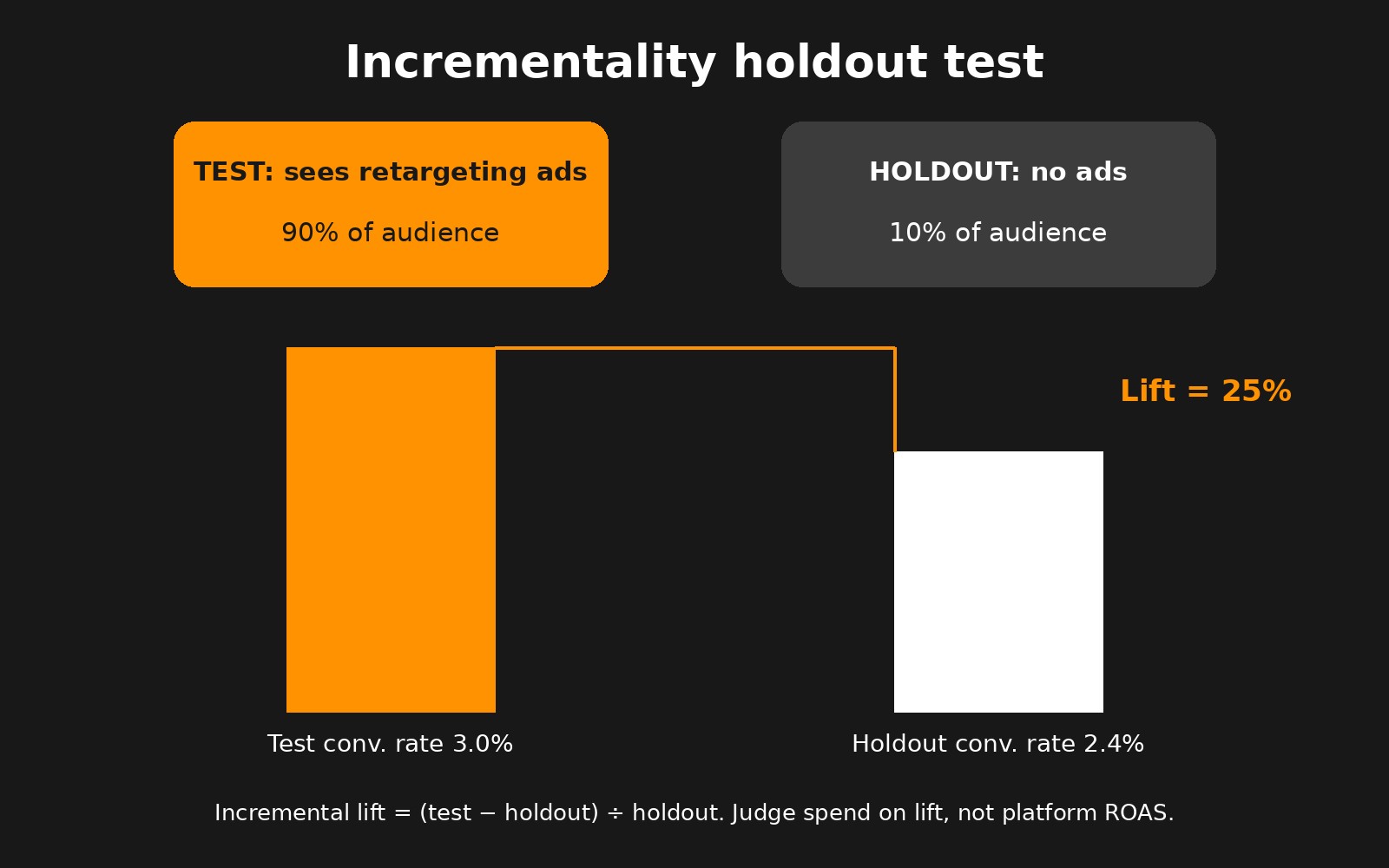
Platform ROAS tells you how many purchases happened after someone saw an ad. It doesn't tell you how many would have happened anyway. Retargeting audiences are full of people who were already close to buying, so its reported ROAS is almost always overstated. An incrementality holdout test answers the real question.
A simple holdout setup:
In practice, incremental ROAS on retargeting is often a fraction of reported ROAS. That's not a reason to panic. It's a reason to size the budget correctly. If incremental ROAS still beats your break-even, keep the cap. If it doesn't, cut retargeting back and put the budget into prospecting creative. For how to set that break-even, see MER vs ROAS explained.
Advantage+ catalog ads (the new name for DPA) remain one of the most useful formats in Meta, as long as you use them where they fit:
Catalog ads struggle when the feed is weak: low-quality product photos, missing prices, out-of-stock items or titles stuffed with SKU codes. Fix the feed first. Use custom labels to group products by margin or bestseller status, add lifestyle images and overlays with price or reviews, and keep stock synced so you don't pay to show sold-out items. Our inventory planning guide covers the stock side.
Creative matters here too. Mixing catalog ads with fresh video and UGC in retargeting keeps frequency fatigue down. A steady creative cadence, covered in how a dedicated creative studio boosts ad performance, matters as much for warm audiences as for cold ones.
Once this is in place, scaling becomes a prospecting question. Our guide on why Meta ads stop scaling even with solid ROAS walks through what to do next.
Most accounts we take over have retargeting doing more reporting than selling: overlapping warm campaigns, no purchaser exclusions and ASC spending freely on existing customers. Rebalancing toward capped, tested retargeting and stronger prospecting creative is a core part of how we work. For Cion, full-funnel Meta work, including consolidated structure, fresh creative and budgets raised against an MER target, produced +90% revenue, a 4.9x ROAS and a 41% lower CPA in 90 days. We've applied the same discipline for brands like PIPWellness, Honey Drop and Slouper.
Across clients, Lion Media has managed $50M+ in ad spend at a 4.9x average ROAS, with a 5.0★ client rating. See how we run accounts on our Meta ads agency page.
We'll review your overlap, exclusions, budget split and incrementality and show you where retargeting spend is helping and where it's just taking credit. Book a free growth audit with Lion Media.
Yes, in a smaller role. Advantage+ Shopping already reaches warm audiences, so a separate retargeting layer should be capped at about 15–25% of Meta spend and proven with a holdout test.
Meta renamed dynamic product ads to Advantage+ catalog ads. They still pull products from your catalog, but can now target both broad audiences and people who viewed or carted products.
Define existing customers in your ad account settings using a customer list, pixel or Shopify data, then set an existing-customer budget cap in the ASC campaign, typically 10–25%.
Exclude recent purchasers from every campaign, exclude your cart-recovery audience from broader warm retargeting, and keep cart audiences to short 7–14 day windows.
Hold out 10–20% of the retargeting audience from ads for 2–4 weeks using a Conversion Lift study, geo split or customer-list split. Compare conversion rates to measure incremental lift.
Retargeting reaches people already close to buying, so platform attribution credits it with sales that would often happen anyway. Incremental ROAS from a holdout test is usually much lower.
Book a free 30-minute growth audit. We'll review your ads, tracking and site, and show you where the profit is leaking.
No commitment. No pitch deck. A real conversation about your growth architecture.