If your retail products aren’t ranking, the usual causes are the same as any ecommerce catalog: Google can’t index the pages properly, variants duplicate each other, the copy is thin or manufacturer-copied, or titles don’t match how buyers search. Fix indexing and duplicates first, then write unique copy, align titles to buyer keywords, add internal links and product schema.
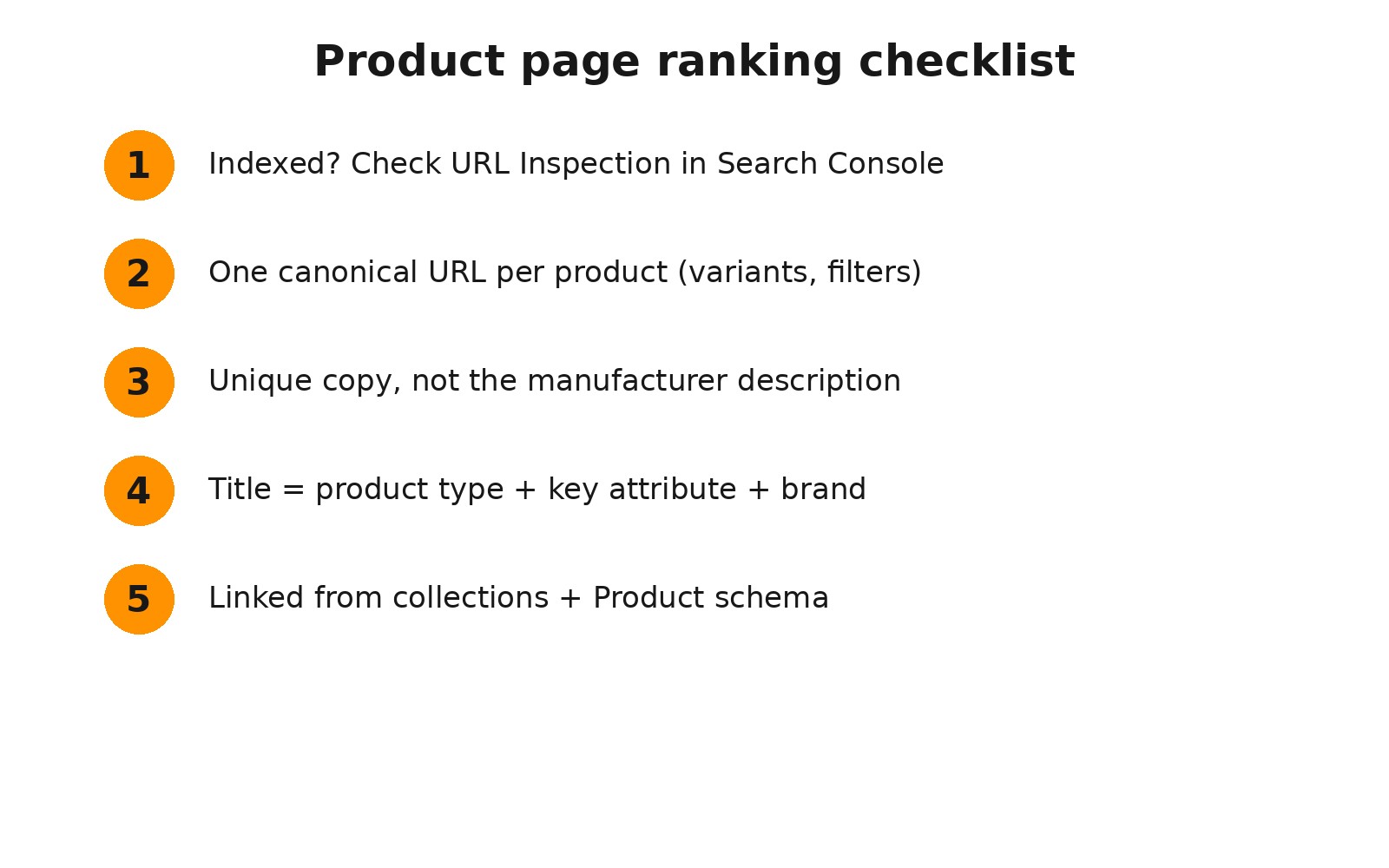
Use the URL Inspection tool in Search Console. Pages marked "Crawled, currently not indexed" or "Duplicate" need attention. Make sure they are in your sitemap and linked from collections.
In the Pages report, look at the reasons listed under "Why pages aren't indexed." The common ones for stores: "Duplicate without user-selected canonical" (variants or tag pages), "Crawled, currently not indexed" (thin or near-identical copy) and "Excluded by noindex tag" (a theme or app setting). Fix the cause, then request indexing for your top products.
Variants, tags and filters can generate many URLs for the same product. Use canonical tags to point to one version, and avoid indexing filter combinations.
On Shopify, products are reachable at both /products/ and /collections/.../products/ URLs. The theme should link to the /products/ version and the canonical should point there. Check a few pages with View Source and search for "canonical."
Rewrite manufacturer descriptions. Add who it is for, benefits, specs, sizing and FAQs. This helps both rankings and conversion. For the conversion side of the same page, layout, offer and proof, see the product page playbook: turn ad clicks into purchases.
A useful product page answers the questions a buyer would ask in a store: what is it, who is it for, how does it compare, what size or variant do I need, how long does shipping take and what if it does not work out. Pull those questions from reviews and support tickets and answer them on the page.
Use the format: Product type + key attribute + brand. Write meta descriptions that give a reason to click, such as shipping or a key benefit.
Link to products from collections, guides and related products. Add Product schema with price, availability and reviews. More quick fixes in quick-win SEO fixes, and the bigger picture in our ecommerce SEO guide for DTC brands. Our ecommerce SEO services team can audit your store.
We'll review your setup and show you the highest-leverage fixes. Book a free growth audit with Lion Media.
Most retail and ecommerce product pages stall for the same four reasons: they are not indexed, variants create duplicate URLs, the description is thin or copied from the manufacturer, or the title does not match how shoppers search. Fix indexing and duplicates first, then rewrite titles and copy around buyer language and add internal links plus product schema.
Usually thin or duplicate copy, a weak title match, or not enough internal links and authority.
If they are coming back, keep the page live and show restock information. If gone permanently, redirect to the closest alternative.
It does not directly raise rankings, but rich results with price and reviews can improve click-through rate.
Enough to answer buyer questions well. Quality and usefulness matter more than length.
Book a free 30-minute growth audit. We'll review your ads, tracking and site, and show you where the profit is leaking.
No commitment. No pitch deck. A real conversation about your growth architecture.