Why Attribution Is Failing DTC Brands in 2026 (And What Replaces It)
Introduction
Three forces hit DTC attribution at the same time in 2026, and your dashboards are lying to you faster than you can fix them.
The problem is not that attribution got harder. Attribution broke. The brands scaling profitably right now stopped trusting any platform's number and started measuring like accountants.
What Broke in 2026 Specifically
Cookie deprecation. Third-party cookies are functionally dead for attribution. Safari's ITP has been stripping them for years. Chrome's Privacy Sandbox eliminated the last reliable cross-site tracking signal for non-Google properties. What this means practically: a customer who sees your Meta ad, visits your site, leaves, and converts three days later through an organic search is invisible to Meta's attribution model. The path broke. The sale still happened. The credit was not assigned.
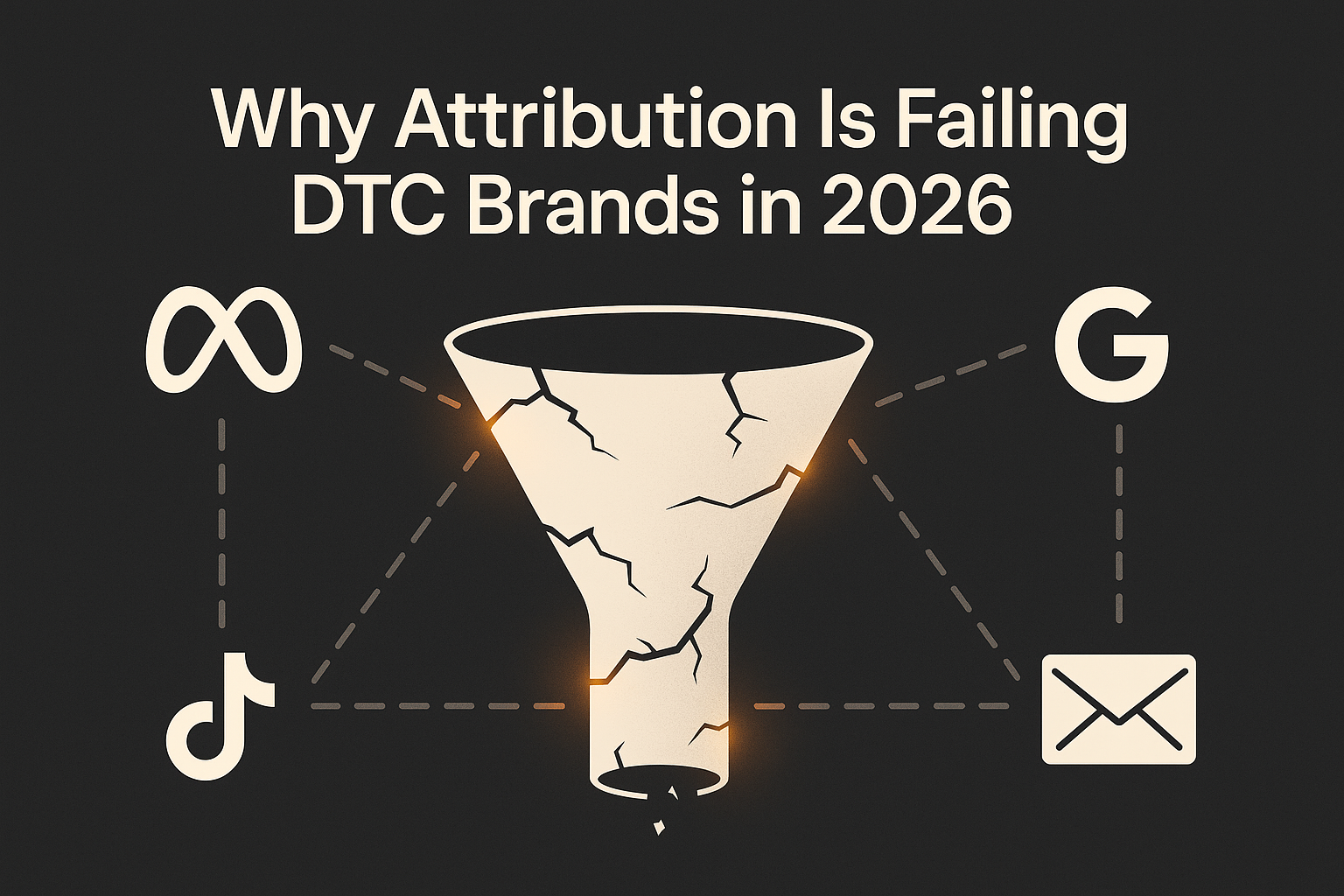
Walled-garden data restrictions. Meta, Google, TikTok, and Pinterest all operate closed data environments. Each platform can see behavior that happens inside its walls. None of them can see what happens outside. When a customer's path spans three platforms and four touchpoints, every platform claims the last touchpoint it touched. The result is attribution overlap that inflates every platform's reported number simultaneously. Total claimed revenue across platforms regularly exceeds actual Shopify revenue by 40-80% for brands running multi-channel.
AI-generated content interfering with Pixels. As brands use AI to generate landing page variants, chatbot-mediated funnels, and dynamic product pages, the static Pixel setup installed two years ago is firing on the wrong events, missing conversion triggers, or double-firing on page state changes that look like purchases. Meta's Event Manager reports purchase events that are not purchases. The AI-optimized funnel is feeding corrupt signal back to the platform's bidding algorithm.
Why Your Dashboards Still Look Fine
The failure is invisible because platforms project confidence.
When your attribution model breaks, the platform does not show you an error. It shows you a slightly inflated ROAS. The numbers look plausible. They track roughly with what you see in Shopify. Close enough that alarm bells don't trigger.
The gap between platform-reported and actual tends to grow slowly. A 15% attribution gap in January becomes 30% by Q4 as the campaign mix shifts toward more upper-funnel activity. By the time the discrepancy is obvious, the media budget has been misallocated for most of the year.
The brands that catch this early measure from their bank account, not their ad dashboards.
The Four Signs Your Attribution Is Broken Right Now
Run this diagnostic on your account this week.
Sign 1: Combined platform ROAS exceeds MER. Pull your total ad spend and total Shopify revenue for the same period. Calculate MER (revenue / spend). Now add up the ROAS each platform reports. If the platform-reported numbers combined are more than 20% above your MER, you have significant attribution overlap. The gap is where your measurement is lying.
Sign 2: Retargeting ROAS is 4-6x prospecting ROAS. Healthy retargeting outperforms prospecting, but not by this margin. If retargeting ROAS is 6-8x and prospecting is under 1.5x, you are not running a profitable retargeting funnel — you are serving ads to people who were already going to buy and claiming credit for organic intent.
Sign 3: Purchase event count in Ads Manager is higher than actual orders in Shopify. Pull the numbers side by side for the last 30 days. If Ads Manager reports 400 purchase events and Shopify shows 285 orders, your Pixel is double-firing or misattributing events. The platform is bidding on a signal that is 40% fictitious.
Sign 4: Revenue does not move when you scale budget. You increase Meta spend 30% and platform ROAS drops modestly, but total Shopify revenue stays flat. This is the clearest signal that platform attribution has decoupled from business reality. You are buying more reach, but the incremental spend is attributing conversions that would have happened anyway.
What Replaces Last-Click Attribution
Attribution didn't need a patch. It needed a replacement framework. The measurement stack that works in 2026 has four layers.
MER as the primary signal. Total revenue divided by total ad spend, calculated from Shopify daily. This is the number that tells you if the aggregate operation is profitable. It cannot be gamed by platform attribution. Read the full MER vs ROAS breakdown if you need the full methodology.
Incrementality testing. The only way to measure true channel contribution is to test what happens when you remove it. Modern incrementality tests — geo holdout tests via Northbeam or Triple Whale — let you measure the lift of specific campaigns or channels against a control group. The result is a multiplier: "Meta's true contribution is 0.7x its reported ROAS." Adjust your optimization target accordingly.
Post-purchase surveys. Asking customers "how did you hear about us?" is not sophisticated. It is also one of the highest-signal data points you can collect. When 40% of customers in a week name Google search as their discovery channel and your Google attribution is claiming 10% of conversions, that gap tells you something no pixel can. Post-purchase surveys via Kno or a simple Typeform catch what pixels miss.
Blended margin tracking. MER tells you the revenue side. Blended margin tracking adds COGS, ops costs, and channel fees to give you true margin per dollar spent. The analytics team at Lion Media builds these dashboards for clients so every scaling decision runs against actual margin, not platform ROAS.
What to Do This Week
One action, no tools required. Pull your total Shopify revenue and your total ad spend from the last 30 days. Divide. Compare that number to what your platforms are collectively reporting. If the gap is larger than 20%, your attribution is broken and you are making budget decisions on a signal that does not reflect reality.
The fix is not a new attribution tool. The fix is building a measurement layer that lives outside the platforms — starting with MER as your daily north star and layering in post-purchase surveys and incrementality testing as you scale.
Brands that measure like accountants scale like they mean it. Brands that trust dashboards get surprised by their P&L.
If you want a measurement audit that maps where your attribution gaps are and what to do about them, our strategy team can help.
FAQ
Why is attribution failing in 2026 specifically?
Three forces converged: cookie deprecation completed across major browsers, walled-garden data restrictions tightened, and AI-generated content created new Pixel misfires. Each one alone was manageable. All three at once broke the last-click attribution model that most DTC brands were still relying on.
What is the fastest way to check if my attribution is broken?
Compare your combined platform ROAS to your MER (total Shopify revenue / total ad spend). If platforms are collectively claiming 30-50% more revenue than Shopify shows, you have significant attribution overlap. Pull this comparison monthly at minimum.
Is cookieless attribution the same as attribution failing?
No. Cookieless tracking alternatives exist — server-side events, Conversions API, first-party data — and they help. But even a perfect Conversions API setup does not fix cross-platform attribution overlap. The underlying problem is that multiple platforms are claiming the same conversions. Cookieless solutions fix the tracking. MER-based measurement fixes the interpretation.
What is incrementality testing and do I need it?
Incrementality testing measures the true lift of a channel or campaign by comparing a group that sees ads against a control group that does not. It tells you what revenue you would lose if you turned the channel off. For brands spending $50K+ per month, incrementality testing is the most defensible way to allocate budget across channels. Below $50K/month, MER plus post-purchase surveys give sufficient signal.
Can my current agency do this?
Any agency managing your media should be able to build a MER dashboard and interpret the gap between MER and platform ROAS. Post-purchase surveys take 30 minutes to set up. Incrementality testing is more advanced and should be on the roadmap for any account at $50K+ monthly spend. If your agency is optimizing exclusively to in-platform ROAS without any external measurement layer, that is the conversation to have.